A Plant Shelf That Leaves Room for Leaves to Breathe
A shelf can hold plenty of plants without turning into a tangle. Compare loose, grouped and tiered arrangements to find one you can see, reach and care for.
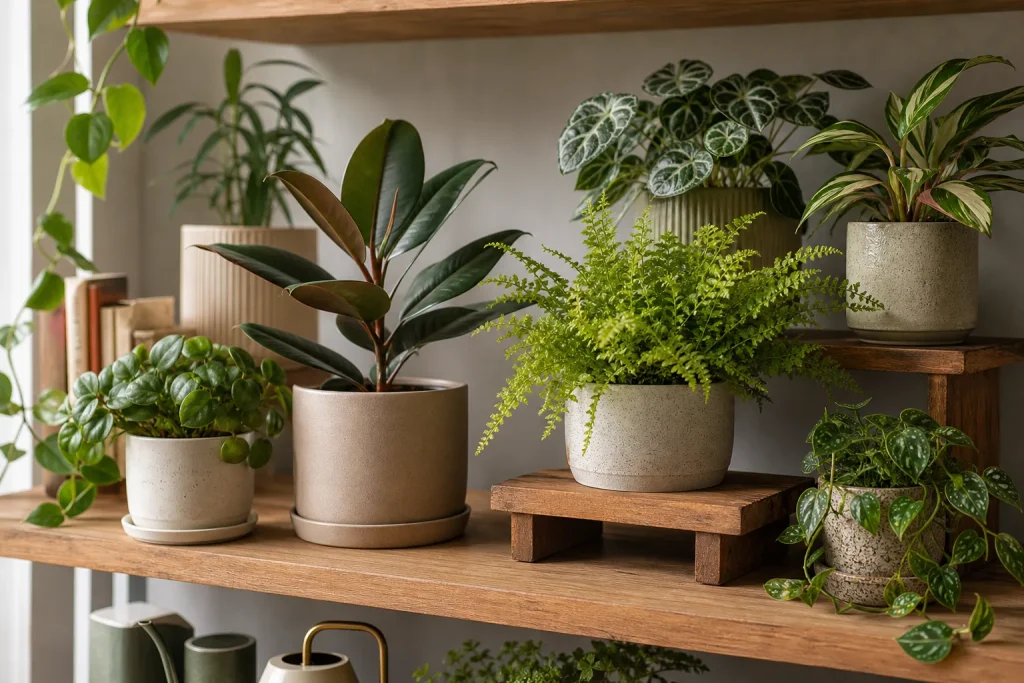
Can you reach the pot at the back without lifting three other plants first? If not, the shelf is probably crowded in the wrong places, even if there is still room for another small pot. A useful arrangement gives each plant space to be seen and handled, while leaving a clear route for watering, pruning and the occasional turn of a pot.
There is no single ideal gap between every pair of plants. A compact rosette and a broad-leaved plant have different shapes; a young specimen and one spreading into the aisle make different demands. Rather than arranging pots by the empty centimetres between them, think in terms of access, visibility and the space each plant is likely to occupy as it grows.
Three approaches work well for many home collections: loose spacing, grouped clusters and tiered layers. Each has a different balance of display and convenience. Your room, shelf depth and habits will point towards the right one.
Loose spacing makes each plant easy to reach
In a loose arrangement, pots sit with open gaps between them. You can lift one out without shifting its neighbours, inspect leaves from more than one side and spot a dry surface or a fallen leaf. It is the simplest layout to maintain, and often the best choice when a shelf is also used for books, supplies or everyday objects.
Loose spacing suits a collection with varied care needs. A fern that appreciates regular attention may sit near a plant that prefers its potting mix to dry more between waterings. Keeping them apart makes it easier to check each pot on its own terms, rather than treating the whole shelf as one green mass. It also helps if you are learning how a new plant responds in its particular spot.
Its drawback is visual: a row of isolated pots can look a little like plants waiting for a bus. Repeating one detail can make the arrangement feel deliberate. Try similar pot colours, a shared saucer style, or a rhythm of taller and shorter foliage. The plants need not match; a little consistency among the containers can tie the shelf together.
Leave the largest usable gap where you are most likely to reach in. A hand needs somewhere to go, and a watering can needs room to tip without knocking a leaf or drenching the shelf. If you usually take plants to a sink, keep the route clear enough to lift each pot out directly.
Small clusters create a fuller display
Grouping plants makes a shelf look more composed and brings foliage into a shared visual scene. A cluster might combine a compact peperomia, a small upright plant and a pot with a gently arching habit. The change in height and outline gives the eye something to follow, without asking every pot to stand alone.
This approach suits a collection of plants that can share the same general conditions and that you can still reach individually. Keep the pots distinct rather than wedging them together. Leaves may overlap in the view, but the containers should be easy to lift, and the stems should not be pressed against the wall or trapped beneath a neighbour’s foliage.
Think of a cluster as a small arrangement with a front and a back. Put a lower plant towards the front and a taller one behind it, but avoid hiding the base of the taller plant completely. If you cannot see the potting mix, you may miss a fallen leaf, a pest or a watering issue. Rotate the arrangement occasionally if plants are leaning towards the same direction of light, while taking care not to disturb their pots more than needed.
Clusters can make individual watering less straightforward. A narrow-spouted watering can helps you aim at one pot, but it is not a substitute for access. If you must tilt a neighbouring plant to reach the soil, the grouping is too tight. Give the pots more room or move one of them to a separate spot.
Tiered layers use height without hiding the back row
A tiered arrangement places plants at different heights, using a stable plant stand, a low riser or the shelf’s existing levels. It can keep foliage from forming a single flat line and help smaller plants remain visible beside larger ones. This suits a shelf with enough depth to accommodate the different footprints and enough clearance above each level for leaves to grow.
Choose supports that sit flat and do not wobble when a pot is lifted. A sturdy wooden riser or a purpose-made plant stand is more useful than a stack of objects that shifts whenever you reach for a pot. Keep water-sensitive books and finishes away from drips, and use saucers or waterproof trays where appropriate. A raised pot should be just as easy to remove as one standing directly on the shelf.
Height can solve a sightline problem, but it does not create more access by itself. A tall pot at the back may become hard to reach if a shorter one blocks the route to it. Arrange the levels so you can place a hand around each container and lift it straight up. Check the space above the tallest leaves too; foliage that presses against a shelf or wall is not gaining useful breathing room.
There is little value in buying elaborate risers simply to make a display look fuller. If a spare, stable stand does the job, use it. The point is to make plants visible and manageable, not to build a miniature obstacle course.
Choose the layout that fits your care routine
Start with the task that currently feels awkward. If watering one plant means moving several pots, prioritise access. If small plants disappear behind broad leaves, prioritise sightlines. If the shelf feels sparse despite being easy to care for, a few clusters may add visual weight without filling every gap.
Then sort the plants by their actual shape, not by the size of their nursery pots. A narrow, upright plant occupies a different kind of space from one whose leaves arch sideways. Leave room for the foliage as well as the container, and allow for the direction in which it tends to grow. The plant’s current outline is a starting point, not a permanent boundary.
Imagine you have a shallow shelf with a compact peperomia, a young rubber plant and a small fern. You notice that the fern is hidden behind the rubber plant and that reaching its pot means brushing the leaves. Move the fern to the front of a small stable riser, shift the rubber plant to one side, and leave a clear gap beside the peperomia. The expected result is a visible fern and a direct route to all three pots; if the raised pot becomes awkward to lift, return it to the shelf and keep the plants in a looser row.
That kind of small adjustment is more useful than trying to perfect the arrangement in one go. Place the pots, then check the view from where you usually sit or enter the room. Next, lift each one out and put it back. Finally, consider where water goes and whether the shelf can be wiped without dismantling the display. A layout that looks good only from one angle or only when no one touches it will not stay convenient for long.
Leave room for changes in shape and routine
Plants do not keep the same outline. New leaves may spread towards an open gap, stems may lengthen, and a young plant may gradually dominate a small cluster. Revisit the arrangement when a pot becomes harder to reach or a neighbour’s foliage starts to overlap more than you like. You do not need to rearrange on a calendar; let the plants and your routine give you a reason.
Keep a little flexible space on the shelf if you can. It gives you somewhere to set a pot while wiping dust from a leaf or checking the underside for pests. It also makes it easier to rotate or temporarily separate a plant when its care needs change. An empty patch is not wasted space if it makes ordinary attention simpler.
For a busy shelf, loose spacing is usually the least fussy starting point. Choose clusters if you want a fuller display and can still reach every pot. Use tiers when height improves visibility without adding wobble or awkward lifting. You can also mix the approaches: a loose row for plants needing frequent checks, one small cluster for similar shapes, and a modest riser for a plant that would otherwise vanish from view.
The best arrangement is the one that makes it easy to notice what is happening and respond without a shuffle of pots. Leave the leaves room to grow, the containers room to lift, and your hands a clear way in.