Choosing a First Trailing Plant for a High Shelf
A plant above eye level needs more than attractive dangling stems. Match its light and growth habit to the shelf, then make sure you can inspect and reach it without contortions.
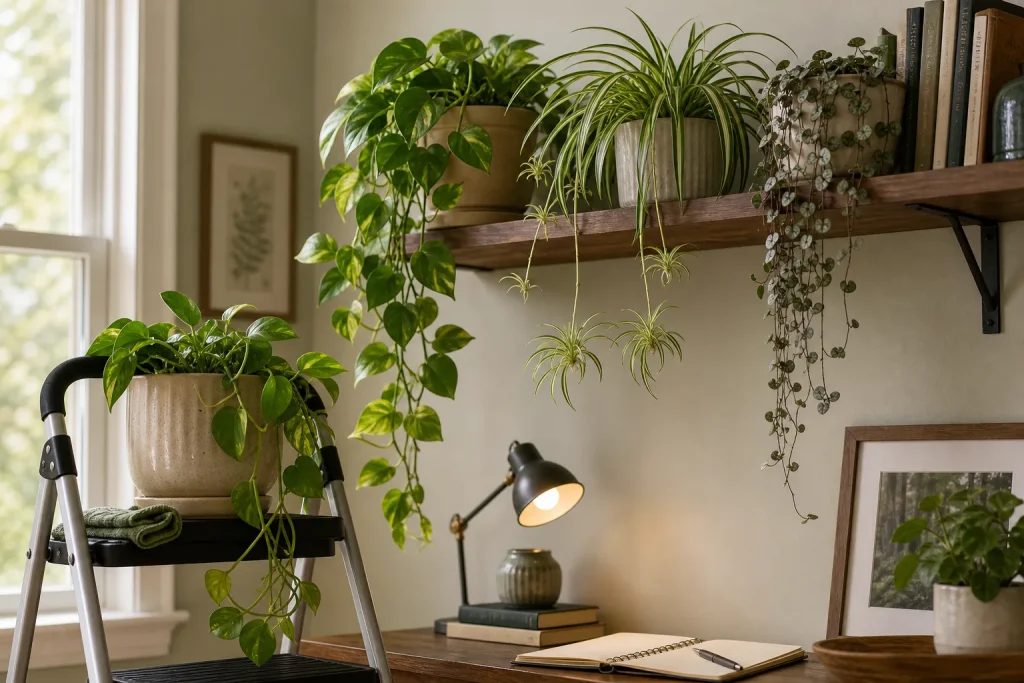
Which trailing plant can sit on a high shelf without becoming a tangled, hard-to-inspect display? Start with the shelf, not the photograph on the label. A bookcase in a dim corner has different conditions from one beside a bright window, and a pot that looks graceful from the sofa may be awkward to reach from below.
For a first choice, favour a plant whose light needs suit the spot, whose growth fits the available space and whose leaves you can inspect. Pothos and heartleaf philodendron have flexible stems that can hang over an edge; spider plants make a more arching, fountain-like shape. None is an automatic fit for every shelf.
Check the light where the leaves will sit
A shelf can look bright from across the room and still receive little useful daylight. The wall may catch the sun while the pot sits in shade, or the shelf may be well away from the nearest window. In dim conditions, many trailing plants grow slowly or stretch towards light, leaving longer gaps between leaves.
Observe the shelf at different times of day. Does daylight reach the leaves, or only the wall behind them? Does direct sun fall on the plant? Pothos and heartleaf philodendron generally tolerate less-bright indoor positions than strongly variegated forms, though they still need usable light to grow well. Spider plants tend to look fuller in a brighter position out of harsh direct sun.
If the spot is genuinely dim, choose a plant suited to it or find a brighter position. A grow light can help where natural light is limited, but mounting one above a high shelf may bring glare, trailing cords and another thing to manage. It is not worth choosing a pale, strongly variegated plant just because it stands out against a dark wall if the spot cannot support its light needs.
Make sure the pot is reachable
Trailing stems can make a high shelf look made for plants, but the leaves and pot still need regular inspection. You should be able to look over the foliage, notice changes and lift the plant down without stretching over furniture or balancing on an unstable chair.
Before buying, check the route from shelf to floor. Can you stand on a stable step stool on a clear, level surface? Can you hold the pot with both hands without catching stems on a lamp or shelf? Is there somewhere safe to set it down? If not, choose a lighter pot, a smaller plant or a lower position. A decorative cover pot can make a planted container heavier and harder to handle.
Say you have a narrow bookcase above a desk and are considering a pothos in a ceramic cover pot. You place the empty pot on the shelf, stand on a stable step stool and practise lifting it down with both hands. You find that the pot catches the desk lamp, so you move it to a lower shelf. The result is a spot where you can inspect the plant and carry it safely instead of reaching around an obstacle.
Choose a growth habit that fits the shelf
Pothos and heartleaf philodendron make flexible vines that can be guided along an edge or left to hang. Spider plants produce arching leaves and long stems bearing small plantlets, so their outline is more fountain-like than vine-like. String of hearts has fine stems and small patterned leaves; its delicate growth may be a poor match for a busy spot where people brush past.
Look below and beside the shelf. A vine might hang in front of a picture, snag on a door, rest against a radiator or reach into a walkway. Keep foliage away from heat sources and places where it will be knocked. If you want a neat edge, choose flexible stems that you can trim; if you prefer a loose cascade, make sure there is room for growth without contact with furniture or the floor.
Clean scissors can shorten an overlong stem just above a leaf node, the point where a leaf joins the stem. That tidies the outline, though new growth will not necessarily form a symmetrical curtain. A compact or upright plant may be a better choice if the shelf is crowded. Check the actual plant, if possible: a label saying “trailing” does not tell you how wide its foliage will become.
Keep the plant easy to inspect
A high position can hide leaves tucked near the pot, stem joints and the undersides of foliage. At the shop, turn the plant gently and inspect both sides of the leaves and along the stems. If you see webbing, sticky residue, clusters of insects or widespread yellowing, choose another specimen or ask staff about its condition. A few imperfect leaves do not necessarily rule out a plant, but widespread trouble is a poor starting point.
After bringing a new plant home, keep it apart from established houseplants while you inspect it. There is no single quarantine duration that suits every situation; guidance depends on the plant, its condition and the pest concern. Check reliable plant-health advice for the issue at hand, and keep inspecting the leaves and stems during the separation. If you spot insects, identify them before selecting a treatment, and follow the product label if you use one.
When comparing two healthy plants, favour the one with sturdy growth and several leaves close to the pot over one long, bare stem. A full display depends on growth across the plant, not just its longest vine. You can prune and propagate later, but a balanced starting shape is easier to place.
Use a short shelf check before choosing
- Observe whether daylight reaches the leaves through the day; if the shelf stays dim, choose a plant suited to lower light or move it closer to a window.
- Check whether direct sun falls on the leaves; if it is harsh, choose a less exposed position or a plant suited to that light.
- Stand at the shelf and trace a safe route for lifting the pot down; if you must stretch or balance, use a lower shelf or a lighter plant and pot.
- Look at what sits beneath the shelf; if vines would touch a radiator, walkway or door, choose a shorter-growing plant or another position.
- Inspect both leaf surfaces and the stems at the shop; if you see webbing, insects or widespread damage, select another plant or ask staff for advice.
- Consider whether pets or children could reach dangling leaves; if chewing is possible, check the exact plant’s toxicity information and choose a safer, genuinely inaccessible position or a more suitable species.
- Check whether you can see the plant’s leaves and stems from floor level; if the pot hides them, choose a shelf where routine inspection is easier.
A raised shelf is not automatically out of reach for pets or children. Dangling stems may connect with a chair, desk or curtain that makes the plant easier to reach. Check the exact species’ toxicity information if someone at home may chew leaves; a nursery label can help identify it, and a veterinary professional can advise about a pet-specific concern. Secure heavy pots, and avoid placing them above a bed, cot or valuable electronics.
The best first trailing plant is one that suits the light, fits the shelf and remains accessible for inspection. Leave room for its stems to grow, keep clean scissors nearby for occasional trimming and look at the plant from the side as well as below. That quick change of viewpoint can reveal a vine heading towards a lamp or a leaf hidden against the wall before the display becomes awkward to manage.