The Window Is Not the Whole Story: Mapping Light Across a Room
A bright windowsill and a shadowy corner can belong to the same room. Learn how to compare light by place, time and changing conditions before choosing a plant’s spot.
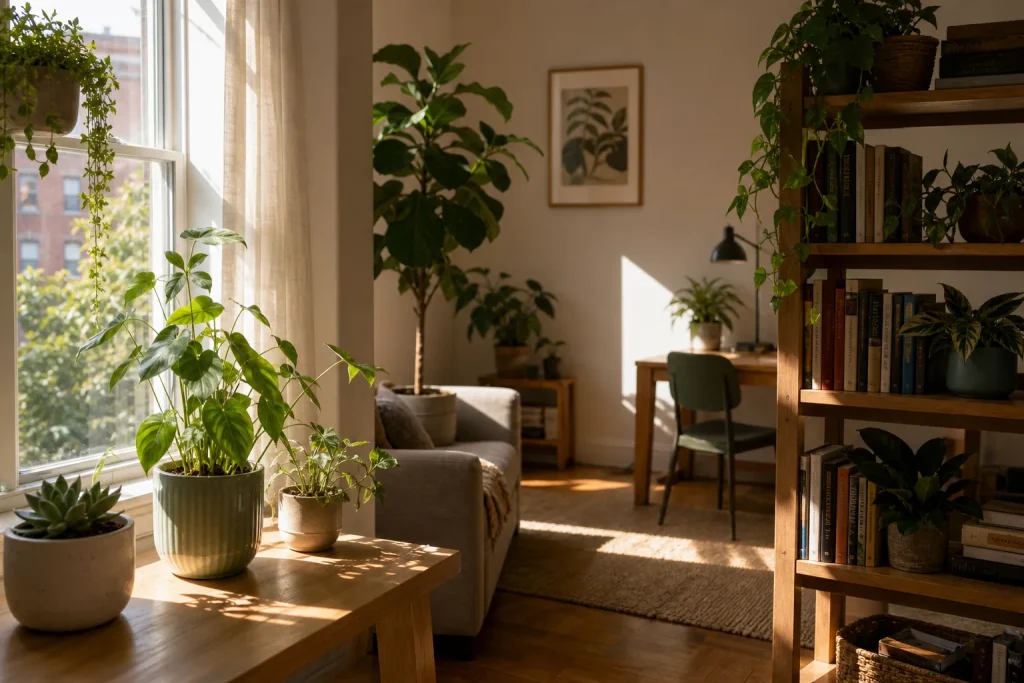
Where in your room will a plant get enough light? The answer may be a few steps back from the window, not on the sill. Light changes across a room as it meets glass, curtains, walls and furniture, and it changes again as the sun moves. To choose a spot, compare what reaches each candidate location over the day rather than judging the room from its brightest point.
Why can one room have bright and dim spots?
Light comes from a particular direction, then weakens as it travels farther from its source. A window-facing table may receive a clear patch of daylight while a bookcase beyond it gets only light reflected from the walls. Even within a few paces, a plant can move from a direct view of the sky to a view blocked by a sofa, a tall plant or a neighbouring building.
Glass and window treatments shape that light. A sheer curtain softens it; a heavy curtain can cut it down substantially. A deep sill, balcony overhang or nearby tree may shade the window. Pale walls tend to bounce more light around than dark, absorbent surfaces, but reflected light is not the same as an unobstructed view outdoors.
Direction matters, too. A south-facing window in the northern hemisphere often receives stronger direct sun than a north-facing one, but the view outside can change the picture. A shaded south window may be less bright than an open east-facing window. Treat compass direction as a clue, not a verdict.
How can I compare spots without a light meter?
Use your eyes at the places where the plant might actually sit. At different points during the day, look at the floor, wall or tabletop there. Is a sunbeam reaching it? Are edges and colours easy to see, or does the area feel gloomy beside the window? Note whether the light is direct, filtered through a curtain, or indirect, and whether the spot has a clear view of the sky.
A phone camera can help you compare locations if you use it consistently, but its automatic exposure adjusts to the scene. A shaded corner can look bright on screen because the camera compensates. If you use a light-meter app, hold the phone in the same orientation at each spot and compare readings rather than treating them as laboratory measurements. The aim is a relative map, not a precise rating.
A simple room sketch is often enough. Mark each candidate spot, then add brief notes such as “direct morning sun”, “bright until midday” or “no sunbeam; open sky view”. Repeat the observations on more than one day if the weather has been unusual. Cloud, rain and seasonal changes can alter the impression.
How long should I watch a spot?
Check at several points from morning through late afternoon, rather than taking one snapshot. The useful question is not only how bright a place looks at noon, but how its light changes over the day. A spot that receives gentle morning light may be bright for a limited period and shaded later; another may have steady, indirect daylight without any sunbeam.
Direct sun is especially easy to misjudge. A moving patch on the floor shows where sunlight reaches at that moment, but its position and duration shift with the season. Look at the proposed plant position, not just the window glass. A few feet from the sill, the beam may already have moved away.
For a more reliable picture, observe on a clear day and a dull day if you can. You do not need a diary full of numbers. A short note about the time of day, sky conditions and whether direct sun reaches the spot will reveal useful patterns.
Does a window’s direction tell me where to put a plant?
It narrows the possibilities, but it cannot choose the spot on its own. In the northern hemisphere, south-facing windows commonly offer the strongest direct sunlight; east-facing windows bring morning sun, while west-facing windows can receive warmer afternoon light. North-facing windows generally provide less direct sun. These are broad tendencies, not rules that override what is outside the glass.
Compare the actual conditions at plant height. A window facing a brick wall, covered by a balcony or screened by dense trees may receive less open sky than its direction suggests. A clean pane, unobstructed view and light-coloured room can all make a difference. If the plant will sit behind a curtain, check the light with the curtain in its usual position.
Then consider the plant’s needs. A sun-loving plant may suit a spot with direct light, while many foliage plants prefer bright, indirect light. “Indirect” does not mean a dark corner: it generally means a bright place where direct rays do not fall on the leaves for long. Check the care guidance for the species, and use your room observations to find the closest match.
How far from the window is too far?
There is no single distance that works in every room. Light often falls quickly as you move away from a window, but the rate depends on window size, exposure, obstructions, curtains and room layout. A large unobstructed window may brighten a nearby table; a narrow window looking onto a shaded courtyard may offer much less reach.
Compare the intended place with the sill rather than assuming that a spot still “near the window” gets similar light. Sit or stand where the plant would be and notice whether the window remains clearly visible. A tall cabinet between the plant and the glass can block more light than its distance alone suggests.
Imagine you have a bright south-facing window and are choosing between its sill and a desk behind a bookcase. You notice a sunbeam crossing the sill in the morning, while the desk sees no direct sun and has only a partial view of the window. If the plant’s guidance calls for bright, indirect light, the desk may still be too dim despite the room’s sunny appearance. Moving it to an open table nearer the window, then watching how the leaves respond, gives you a more useful starting point.
What room details can quietly change the light?
Start with anything between the window and the plant: curtains, blinds, shelves, tall furniture and other plants. A sheer voile softens sunlight but still leaves a view of the outdoors; a closed blind may substantially reduce the light. A crowded sill can shade plants behind it, especially when broad leaves overlap.
Look beyond the window, too. Trees leaf out and lose their leaves; nearby buildings cast shadows that shift with the sun. A bright winter spot may be shaded in summer, or the reverse. Reflections from pale walls can lift the general brightness, while a deep alcove can keep a plant in shadow even when the adjoining room feels airy.
It is not worth spending time measuring every wall or chasing a perfect reading from a phone. A careful comparison of a few likely locations, repeated at different times, is more practical than false precision. Keep the notes simple enough that you will actually use them.
How do I tell whether the chosen spot is working?
Watch the plant over time, not just on the day you move it. New growth gives useful clues: a plant that is stretching towards the window or producing unusually small leaves may not be receiving enough light. Fading or scorched patches can signal that direct sun is too intense for that plant, though watering, pests and other conditions can cause trouble as well.
Before changing anything, compare the plant’s current spot with the light map and check its care needs. If it seems to be stretching, try moving it closer to a bright window or clearing an obstruction. If leaves develop dry, pale patches after a move into strong sun, ease it back or filter the direct rays with a sheer curtain. Change one condition at a time where practical, so the next growth tells you more.
Room light is not fixed, and a plant’s position need not be permanent. Recheck a spot when the seasons change, a curtain is replaced or furniture moves. A modest shift towards clearer daylight can matter more than choosing the “best” window by compass alone.